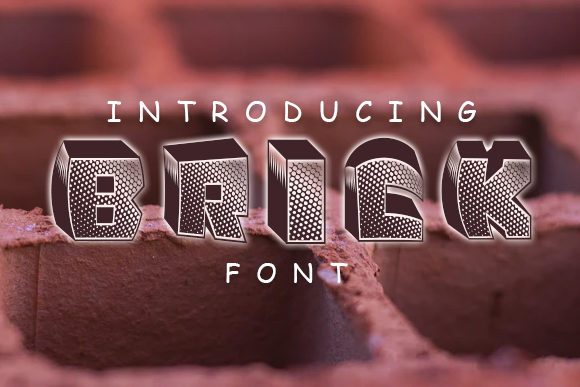
Brick: A Structural Approach to 3D Typography
In the landscape of digital design, typography often serves as the primary vehicle for communication. However, when a brand or project demands more than legibility—when it requires texture, depth, and a tactile sense of presence—the standard sans-serif or serif fonts frequently fall short. This is where specialized display fonts like Brick enter the workflow. Brick is not merely a typeface; it is a structural asset designed to impose order, weight, and geometric precision onto visual compositions. For professionals ranging from graphic designers and marketers to educators and small business owners, understanding the specific utility of such a font is crucial for creating designs that resonate with intention rather than accident.
The Anatomy of a Display Font
To evaluate Brick effectively, one must first distinguish between body text and display typography. Body text prioritizes readability over extended periods, requiring subtle curves and open counters. Display typography, conversely, is intended for headlines, logos, posters, and short bursts of text where impact supersedes prolonged reading. Brick operates squarely in the latter category. Its defining characteristic is its three-dimensional rendering, which gives each letterform a physical presence on the screen or page.
The font’s name suggests its aesthetic inspiration: masonry. Each character is constructed with a blocky, modular logic that mimics the stacking of bricks. This is not a decorative script or an organic hand-lettered style; it is engineered. The edges are sharp, the proportions are uniform, and the depth is calculated. This consistency allows Brick to fit perfectly within rigid grid systems, making it an excellent choice for layouts that demand symmetry and balance. When you place a headline set in Brick into a design, you are introducing a visual anchor that commands attention through its sheer solidity.
Key Characteristics and Visual Impact
The strength of Brick lies in its ability to convey stability and permanence. In an era where digital content is often fleeting and ephemeral, a font that evokes construction and endurance can be a powerful psychological tool. Here are the core attributes that define its performance:
- Geometric Precision: Unlike rounded or soft fonts, Brick utilizes hard angles and straight lines. This makes it highly compatible with modernist, industrial, and brutalist design aesthetics. It pairs well with clean lines and minimal backgrounds, allowing the typography itself to become the primary visual element.
- Three-Dimensional Depth: The 3D effect is not achieved through complex shading gradients but through a consistent extrusion technique. This creates a shadow-like depth that lifts the text off the background without relying on heavy drop shadows that can clutter a design. The result is a crisp, clean elevation that remains legible even at smaller sizes.
- Versatility in Weight: While primarily a bold display font, the structural nature of Brick allows it to handle various weights effectively. Whether used for a massive poster headline or a mid-sized subheading, the font maintains its integrity. It does not break down or lose clarity when scaled, which is a common issue with overly ornamental typefaces.
Practical Applications Across Industries
Understanding who benefits most from Brick requires looking at specific use cases. The font is not a universal solution, but it is an exceptional tool for targeted applications. Its robust appearance makes it particularly suitable for industries that value strength, reliability, or creativity.
Branding and Identity Design
For startups, tech companies, or creative agencies looking to establish a strong visual identity, Brick offers a distinctive alternative to generic corporate fonts. A logo utilizing Brick can immediately communicate a sense of building blocks, foundation, or structural innovation. It works well for brands in construction, architecture, software development (emphasizing "building" code), or even gaming, where block-based mechanics are prevalent. The font’s unique shape ensures high memorability, which is a critical component of effective branding.
Marketing and Advertising
In the realm of digital marketing, attention spans are short. Advertisements, social media banners, and email headers need to grab the viewer’s eye instantly. Brick’s high contrast and dimensional quality make it stand out against both light and dark backgrounds. Marketers can leverage this to create promotional materials for product launches, sales events, or event announcements. The font’s playful yet serious tone allows for endless variations; it can feel authoritative in a financial context or energetic in a lifestyle campaign, depending on the accompanying color palette and imagery.
Education and Publishing
Educators and publishers might find Brick useful for chapter titles, section headers, or cover art. While it should never be used for instructional body text due to its density, it excels at organizing information visually. For example, a textbook on engineering or history could use Brick for chapter headings to reinforce the subject matter’s thematic elements. Similarly, bloggers and content creators can use it to create branded thumbnails or quote graphics that align with their site’s aesthetic, adding a layer of professionalism and distinctiveness to their content.
Usability and Workflow Integration
From a technical standpoint, Brick is designed to integrate seamlessly into modern design workflows. Most professional design software, including Adobe Creative Cloud, Affinity Suite, and web-based tools like Canva, support custom font uploads and manipulation. Users can easily apply the 3D properties inherent in the font file, or enhance them further using layer styles and effects.
One of the practical advantages of Brick is its flexibility in pairing. Because it is so visually dominant, it requires complementary fonts for supporting text. Pairing Brick with a simple, neutral sans-serif (like Helvetica, Arial, or Roboto) creates a balanced hierarchy. The heavy, textured headlines draw the eye, while the clean body text ensures readability. This combination is a proven strategy in graphic design, preventing the overall composition from feeling overwhelming or chaotic.
However, users should be mindful of overuse. The novelty of a 3D block font can wear thin if applied too broadly. Effective design relies on restraint. Using Brick sparingly—as a headline or a key graphical element—maximizes its impact. If every line of text in a document were set in Brick, the result would be visually exhausting and difficult to parse. The font’s power comes from its deviation from the norm; it stands out because it is different, not because it is ubiquitous.
Potential Limitations and Considerations
No single typeface is perfect for every scenario. Brick has clear limitations that designers must respect. First, accessibility is a concern. The 3D effect can reduce legibility for users with visual impairments or dyslexia, particularly if the contrast between the text and background is low. Therefore, Brick should never be used for critical information, navigation menus, or long-form reading material.
Second, licensing and usage rights vary. As with any premium or specialized font, it is essential to verify the license agreement before using Brick in commercial projects. Some fonts allow personal use but require a paid license for commercial distribution. Ignoring these terms can lead to legal complications, especially for businesses and freelancers who sell their services or products.
Finally, stylistic coherence is key. Brick has a very specific voice—it is bold, geometric, and somewhat retro-futuristic. It may clash with designs that rely on organic shapes, soft pastels, or vintage textures. Before incorporating Brick into a project, designers should assess whether the font’s personality aligns with the overall mood and message of the piece. A mismatch between typography and imagery can dilute the effectiveness of the entire design.
Conclusion
Brick represents a thoughtful approach to display typography, offering a blend of structural rigor and visual flair. It is not a font for every occasion, but for those occasions where weight, depth, and distinction are required, it is an outstanding choice. By understanding its strengths, respecting its limitations, and integrating it thoughtfully into broader design strategies, professionals can leverage Brick to create work that is not only seen but remembered. Whether you are building a brand identity, designing a marketing campaign, or simply adding a touch of creativity to a blog post, exploring the variations of Brick can unlock new levels of visual expression in your work.